
Start here
Kratky garlic setup
A Kratky garlic setup is a container of nutrient solution, a lid with a net cup, and a clove or seedling held so its roots reach the liquid while its base stays dry. This guide covers each part, the solution, the air gap, light and temperature, for greens, chives or bulbs.
How the Kratky method works
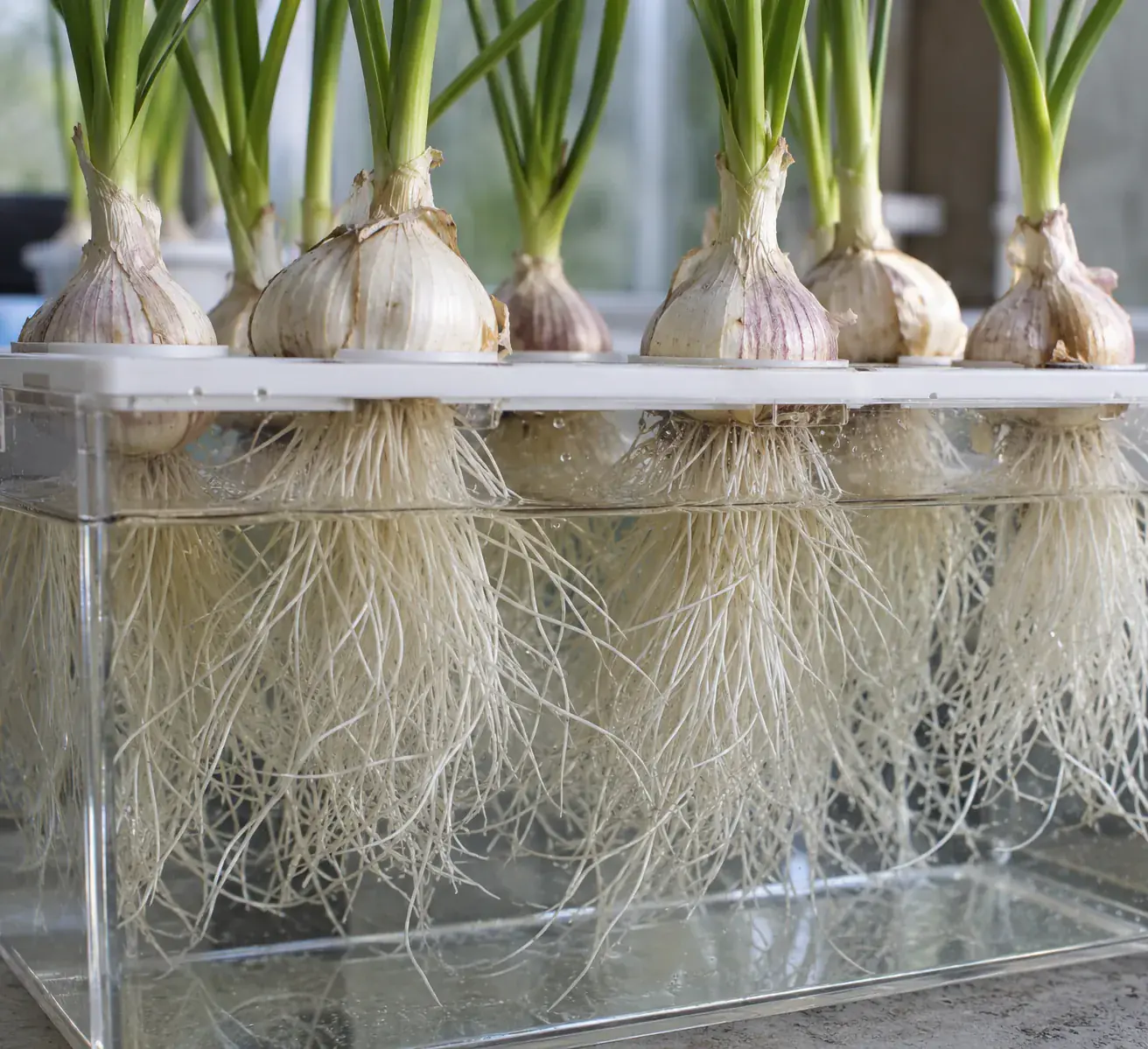
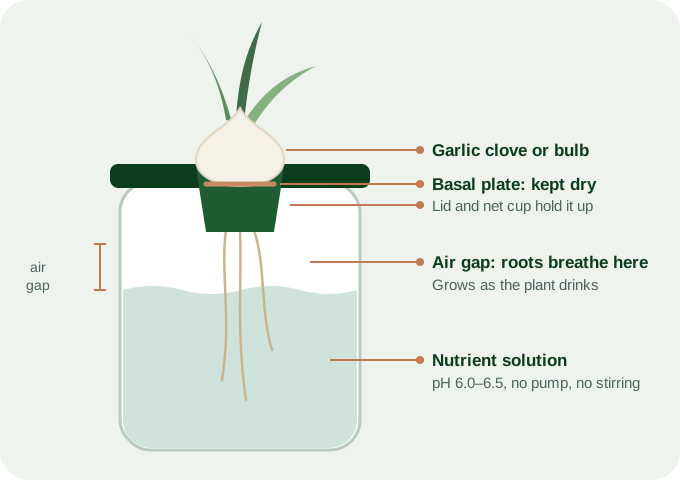
The Kratky method is a passive, non-circulating hydroponic method published by Dr. Bernard Kratky of the University of Hawaii. A plant is held above a container of nutrient solution with its roots reaching into the liquid. Nothing is pumped or bubbled. As the plant drinks, the level drops and leaves a band of humid air. The roots in that air gap take up oxygen while the roots below keep drinking.
For garlic there is one extra rule: the clove’s basal plate, the flat base the roots grow from, should sit just above the solution. Hydroponic garlic guides stress keeping the base above the waterline to prevent rot.
What you need
| Container | Greens or chives: a pint or quart jar. Bulbs: an opaque bin or bucket of a few gallons with a lid. |
|---|---|
| Lid and net cup | A wide-mouth jar lid that holds a 2 to 3 inch net cup, or holes cut in a bin lid to fit net cups. |
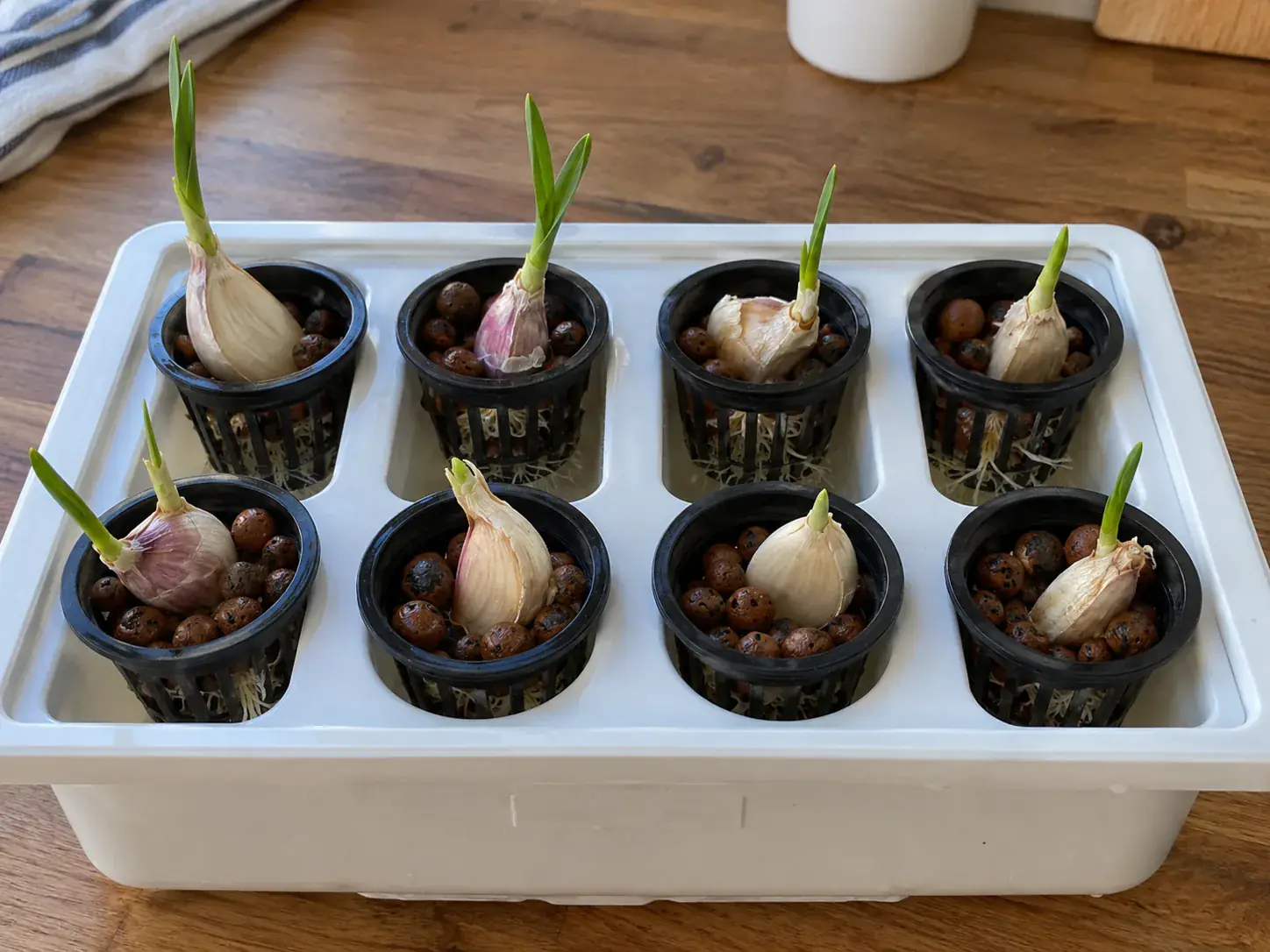
| Something to hold the clove | Clay pebbles, a rockwool cube or coco coir in the net cup. |
| Hydroponic nutrient | A complete hydroponic fertilizer, not a soil fertilizer. |
| pH test and adjuster | Drops or a pen, plus pH down (and pH up). |
| Light-blocking sleeve | Paper, a sock or paint for clear jars, to stop algae. |
| Light | A bright window, or a small LED grow light on a timer. |
Step-by-step setup
- Clean the container. Wash with hot soapy water and rinse well.
- Block the light. Cover a clear jar so light cannot reach the solution. Leave a narrow strip open if you want to watch the level.
- Mix the solution. Follow the nutrient label. For greens and chives, use the seedling or leafy-greens rate; for bulbs, the normal vegetative rate. Hydroponic garlic guides suggest an EC of about 1.4 to 1.8 mS/cm to start.
- Set the pH to 6.0 to 6.5. Most sources agree garlic does best in this range. Add pH adjuster a drop at a time and test again.
- Fill to the bottom of the net cup. The solution should just touch the bottom of the cup so new roots reach it at once, while the clove itself sits above it.
- Plant. Set the clove point up and base down, with its papery skin on, and pack clay pebbles or coco around it so it stands upright. For garlic chives, set a rooted seed plug in the cup.
- Put it in the light. Then mostly leave it alone. Check the clove for softness and the level every few days.
The air gap and refilling
In classic Kratky growing of a fast crop such as lettuce, you fill once and harvest before the jar runs dry. Garlic greens fit that pattern. Garlic chives and bulbs do not: they stay in the jar for months and will need more solution.
When you refill a long crop, add solution only up to the lower roots, leaving the upper roots in moist air. Those upper roots have adapted to breathing air and can suffer if they are suddenly submerged. A good habit is to mark the current level on the container and refill to a little below it.
Light
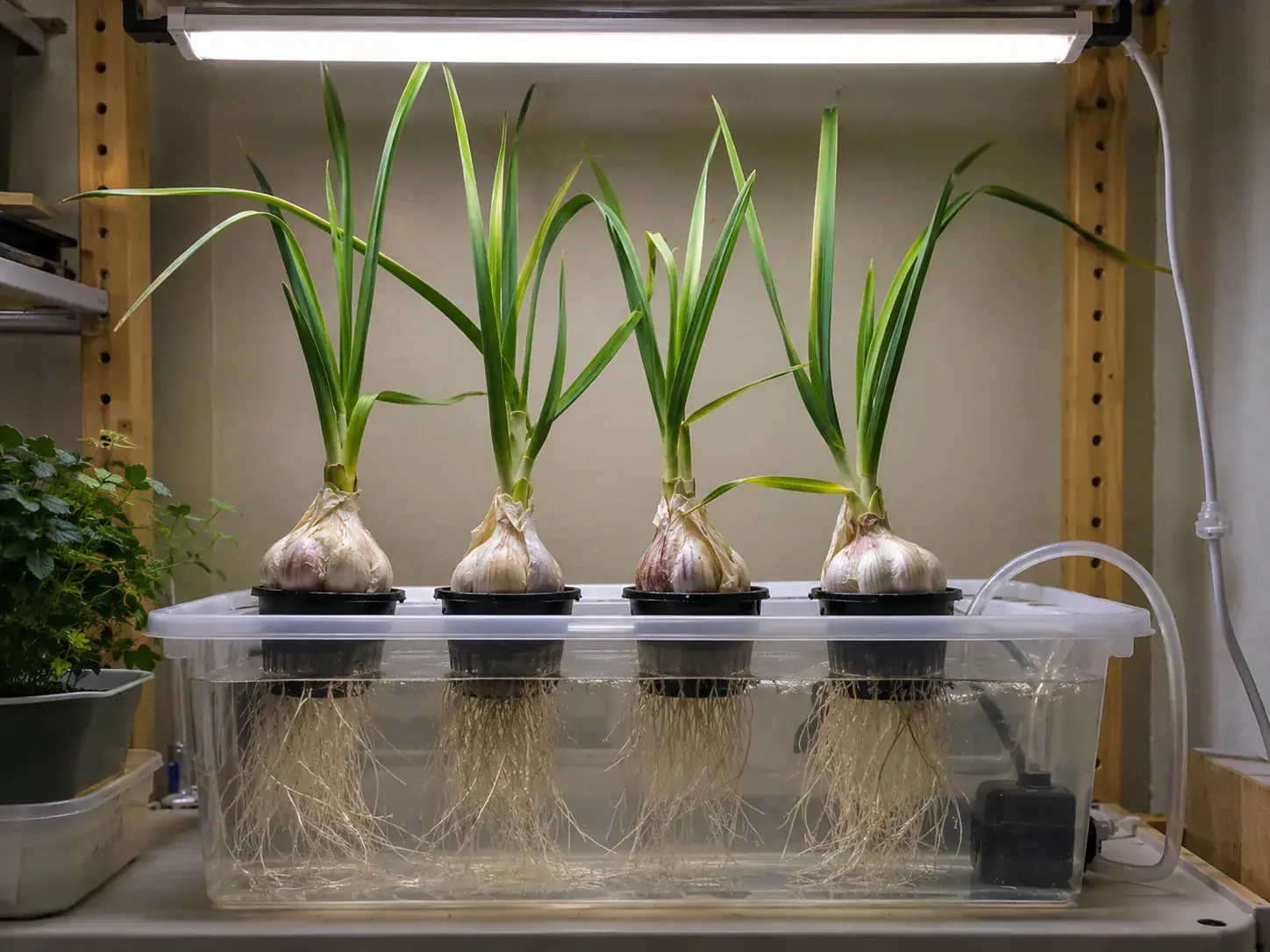
Garlic leaves want strong light. A south-facing window can grow greens. For chives and especially bulbs, a grow light on a timer gives steadier results. About 12 to 14 hours a day suits greens and chives. Bulbs need a change of light partway through: see growing garlic bulbs hydroponically for why day length triggers bulbing.
Temperature
A normal room suits garlic. Hydroponic garlic guides give about 65 to 75°F as the comfortable range, with established plants tolerating more. For bulbs, avoid long spells above 85°F: Oregon State University reports that heat can reverse the cold treatment garlic needs to form cloves.
Which garlic to plant
For greens, any firm, sprouting clove works; organic garlic sprouts more reliably than conventional store garlic. For bulbs, start with chilled seed garlic, ideally a softneck type. Read garlic varieties for hydroponics before you buy, and pre-chill garlic cloves if you are growing bulbs. More short guides are on the Kratky garlic blog.
Something not right? Soft cloves, slimy roots, green water and pale leaves all have simple causes. See Kratky garlic problems.
Sources
- Kratky, B. A. (2009). Three non-circulating hydroponic methods for growing lettuce. Acta Horticulturae 843, 65–72.
- University of Florida IFAS Extension, St. Lucie County: Kratky hydroponic method, a simple way to grow plants without soil (2025).
- Hydrobuilder Learning Center: How to grow hydroponic garlic (pH, EC, temperature, basal plate).
- Oregon State University, Oregon Vegetables: Garlic (vernalization and heat).